Disclaimer
This article dives deeper into personal thinking rather than covering factual news. Use this as a disclaimer: everything from here on is opinion-based. You don’t have to agree with it, but I ask that you take a moment to understand where I’m coming from.
As of January 2026, Alberta may be approaching a political turning point. Across the province, thousands of residents have lined up at community halls and mobile stations to sign what organizers describe as a “high-stakes petition.” The effort is not a binding vote on independence, but a citizen-led initiative aimed at triggering a province-wide referendum. That referendum would ask whether Alberta remains under the banner of “True North Strong and Free,” or pursues a path toward sovereignty.
The Root Of The Problem
The push for Alberta’s separation is not a new phenomenon, but a result of a melting pot of a century long friction between the Wild Rose province and the federal government in Ottawa. If we were to narrow down the main reasons for this referendum, we have 3 main categories to dive into. Fiscal Unfairness, Energy Dependency and Cultural Alienation.
A primary driver is the federal Equalization Program. Under the Canadian Constitution, the federal government redistributes tax revenue from financially stable provinces (such as Alberta) and send them over to financially unstable provinces (such as Quebec and the Maritimes) to ensure the level of public services is equal country wide. Many Albertans feel they are being “milked” to fund services of other provinces, while their own needs are swept under.
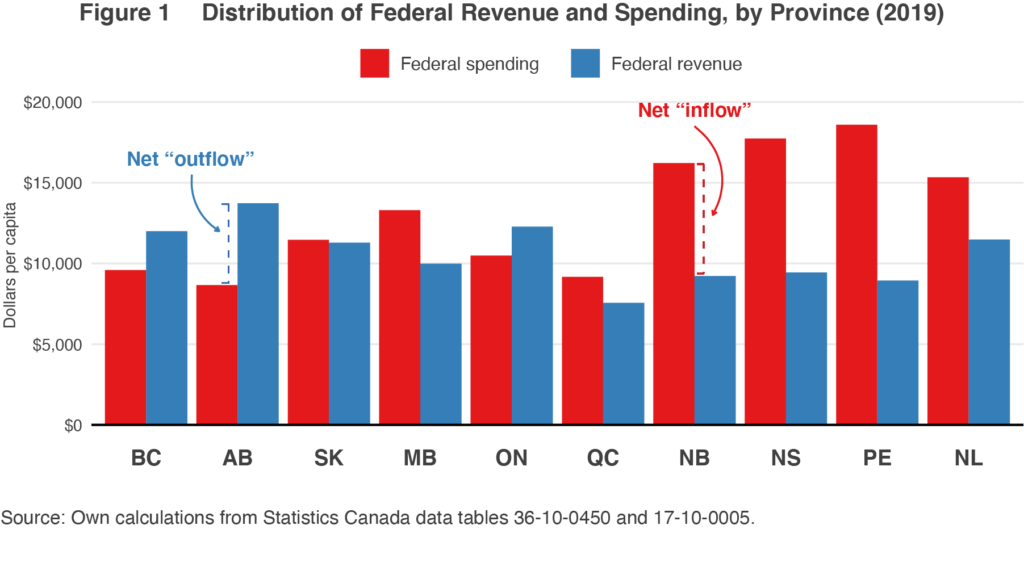
As illustrated in Figure 1, Alberta records the highest level of federal revenue per capita while ranking among the lowest in federal spending. This disparity produces a net federal outflow of roughly $5,000 per capita, indicating that Alberta contributes substantially more to the federal system than it receives.
Year after year, Alberta contributes more to the federal system than any other province on a per-capita basis, while receiving comparatively little in return. In 2019 alone, the gap amounted to roughly $5,000 per person flowing out of the province. That money supports national programs and regional governments elsewhere, often with little transparency and even less acknowledgment. Canadians are often told this is the price of federation. That stronger provinces must support weaker ones. In principle, that idea is not unreasonable. But fairness cannot mean permanence. A system designed to smooth temporary disparities becomes harder to defend when one province is consistently treated as a fiscal engine with no realistic path to balance.
A strong counterargument rests on the idea that Canada’s economic model is designed to promote fairness across the country. Many Albertans, however, question how such a model can be equitable when regional conditions, cultures, and population needs differ so significantly from east to west. If those differences are so pronounced, they ask, why does political and economic decision-making remain concentrated in the east? Which takes us towards the second point. Political Displacement.
Alberta’s population stands at approximately 5.04 million, while Ontario and Quebec together account for roughly 25.25 million people as of October 2025. Because seats in the House of Commons are allocated largely by population, the two central provinces hold significantly greater political influence. This imbalance has long contributed to a sense of Western alienation, where many Albertans feel their votes carry little weight in national outcomes. That perception was reinforced following the 2025 federal election, in which the Liberal Party secured a fourth consecutive majority government despite strong opposition in Alberta. For many in the province, the result deepened the belief that “Ottawa doesn’t listen,” a sentiment that has since become a foundational pillar of the modern separatist movement.
The common occurrence of Albertan voices being left out isn’t only attributed to the federal elections, but also on the “War” on oil and gas resources. Many federal environmental policies, such as the carbon tax and Bill C-69, also known as the no more pipelines act, seem to be targeted primarily towards Alberta. This perception has been reinforced over the past decade by repeated delays and cancellations of major pipeline proposals, which many Albertans argue have constrained market access and reduced provincial revenues. While federal officials maintain that such decisions reflect environmental commitments, Indigenous consultation requirements, and national climate targets, opponents contend that the costs of these policies are unevenly borne by Alberta.
The Misplaced Messiah
In 2022 the Leader of the United Conservative Party (UCP) Danielle Smith was elected as the 19th premier of Alberta, The successor to Former UCP leader Jason Kenny. Smith has background of being a radio-host and a columnist, which granted her the unique ability to gain the support of everyday Albertans by absorbing their frustrations. Winning her the election on the platform to ensure radical provincial autonomy.
While Premier Danielle Smith has focused heavily on "fighting for Alberta" against Ottawa, many critics argue that her domestic record has been characterized by "chaos" and broken promises. To her detractors, the energy spent on separationist rhetoric has come at the expense of stabilizing the province's most vital public services: education and healthcare.
In October 2025, Alberta saw its first province-wide teacher strike in decades. Over 51,000 teachers walked off the job, citing ballooning class sizes, lack of support for students with complex needs, and stagnant wages. Instead of negotiating a new deal, Smith invoked the Notwithstanding Clause of the Charter of Rights and Freedoms to pass the Back to School Act. This forced teachers back to work and imposed a contract they had already overwhelmingly rejected. While schools are open, morale is at an all-time low. Teachers report feeling "disrespected" and "burned out," with many threatening to leave the profession or the province entirely.
Smith followed through on her promise to "dismantle" Alberta Health Services (AHS), but the transition has been fraught with difficulty. The government broke AHS into four separate agencies (Primary Care, Acute Care, Continuing Care, and Mental Health/Addiction). Critics, including the Alberta Medical Association, argue this has created "bureaucratic silos" where no one is clearly accountable when things go wrong. Despite promises to fix the system in 90 days, 2026 has seen continued hospital overcrowding and a "patient death scandal" in Edmonton linked to long wait times. Opponents point to Bill 55 as a "trojan horse" for American-style healthcare, allowing for more private ownership of hospitals and clinics.
Whats To Be Expected For Albertans?
The current petition drive is more than a simple protest; it is a legally codified process that could force a historic shift in the Canadian federation. According to political analyst Matt Solberg, the momentum behind this movement suggests that Albertans should prepare for a significant political collision. With thousands of residents already attending rallies in Edmonton and Calgary it is increasingly likely that organizers will meet the 177,732-signature goal by the May 2nd deadline. Because the UCP government recently amended the Citizen Initiative Act, meeting this threshold effectively "rules the game," making a province-wide vote later in 2026 a near certainty.
If a referendum is triggered, Albertans can expect the province to enter a state of "national crisis" reminiscent of the Quebec referendums of the 1990s. This period will likely be marked by deep internal division, as current polling shows 31% of the province supports independence while 62% remains opposed. This friction will move beyond a provincial grievance and onto the international stage, putting pressure on Prime Minister Mark Carney and federal leaders to maintain an image of stability for global investors. For the average Albertan, this means the coming year will likely be defined by "strongly held emotions" and a high-stakes debate over the province's identity.
However, for those expecting an immediate transition to a "Free Republic," Solberg warns that the reality would be a prolonged and difficult legal "slog." A "Yes" vote would not result in an overnight exit but would instead trigger years of grueling negotiations with the rest of Canada over national debt, pensions, and borders. Additionally, Alberta would face the monumental task of renegotiating its own trade agreements with the rest of the world. As Solberg puts it, those expecting a quick transition have been "snowed over" on the complex details that would take years to resolve.
As the May 2, 2026, deadline for the independence petition approaches, Alberta finds itself at a historic crossroads. While the movement is fueled by deep-seated frustrations over fiscal "unfairness" and federal energy policies, the path forward remains fraught with legal and economic complexity. Premier Danielle Smith’s "sovereignty within Canada" strategy has successfully leveraged this separatist sentiment to gain concessions from Ottawa, yet it has also opened the door to a potential national crisis that many Albertans are still wary of crossing.
The coming months will determine whether the current momentum is a genuine step toward statehood or a high stakes bargaining chip intended to rewrite the terms of Confederation. Regardless of the petition's outcome, the underlying "Western Alienation" is no longer a fringe sentiment; it is a central force in Canadian politics that necessitates a fundamental re-evaluation of how the federation serves its most productive members. For Albertans, the choice is no longer just about tax dollars or pipelines, but about the very identity of the province in the 21st century.
- Saaim Japanwala
Community
Leave your thoughts down below, please make sure to follow Rules and Regulations. Looking forward too see the discussions!